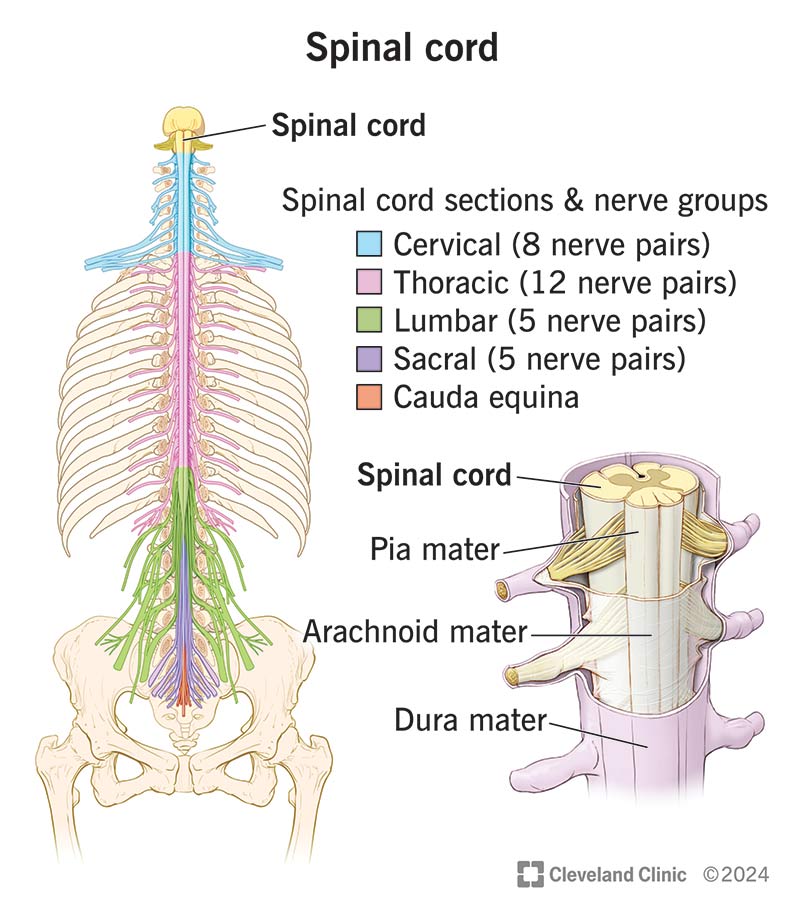
Your spinal cord is a cylinder-shaped tube of tissue that runs through the center of your spine, from your brainstem to your lower back. It’s made of nerves and cells that carry messages from your brain to the rest of your body. Your spinal cord is one of the main parts of your nervous system (Cleveland Clinic, 2024).
The function of the spinal cord
The spinal cord serves as the main communication pathway between the brain and the body. Its primary functions are to transmit motor commands from the brain to muscles, relay sensory information from the body to the brain, and coordinate reflexes. It enables rapid, automatic responses through reflex arcs that do not require brain involvement, allowing the body to react quickly to stimuli. Additionally, the spinal cord contains neural circuits, known as central pattern generators, that help coordinate rhythmic movements such as walking, even in the absence of conscious control or direct sensory input (Michaela Harrow-Mortelliti; Vamsi Reddy; George Jimsheleishvili. 2023).
The spinal cord acts as the body’s main signal pathway, transmitting electrical messages between the brain and the rest of the body. It allows voluntary movement by carrying commands from the brain to muscles, supports automatic processes such as breathing and heart rate, and sends sensory information like pain and pressure back to the brain (Cleveland Clinic, 2024).
What is the relation between the spinal cord and legs?
The spinal cord controls the legs by transmitting motor signals from the brain to leg muscles and sensory information back to the brain (University Hospitals).
The spinal cord is directly responsible for controlling the legs by serving as the main pathway for nerve signals between the brain and the lower limbs. Nerves that supply the legs originate from the lumbar and sacral segments of the spinal cord and branch out as major peripheral nerves. These nerves transmit motor commands from the brain to the leg muscles, allowing movements such as walking, standing, bending, and extending the legs. They also carry sensory information, including pain, touch, and position, from the legs back to the brain (Leading Medicine Guide Editors).
Reasons of paralysis:
- Spinal cord injuries
- Brain injuries (including traumatic brain injury)
- Stroke
- Spina bifida
- Cerebral palsy (paralysis present at birth)
- Multiple sclerosis (MS)
- Guillain-Barr syndrome
- Amyotrophic lateral sclerosis (ALS)
- Damage to nerves or muscles that prevents signals from reaching muscles
- Bell’s palsy (temporary facial paralysis)
Ways to strengthen the spinal cord:
1. Stretch and strengthen the back
2. Maintain a healthy weight
3. Don’t Smoke
4. Reduce or eliminate inflammatory foods
5. Take care with heavy lifting
6. Stay in motion
7. Stand whenever possible
8. Try yoga
9. Get into the water
References
Cleveland Clinic. (2024, October 22nd). Spinal Cord. https://my.clevelandclinic.org/health/body/21946-spinal-cord
Michaela Harrow-Mortelliti; Vamsi Reddy; George Jimsheleishvili. (2023, March 17th). Physiology, Spinal Cord. https://www.ncbi.nlm.nih.gov/books/NBK544267/
University Hospitals. Anatomy of the Spinal Cord. https://www.uhhospitals.org/health-information/health-and-wellness-library/article/adult-diseases-and-conditions-v1/anatomy-of-the-spinal-cord
Leading Medicine Guide Editors. The nervous system of the legs: Information & specialists. https://www.leading-medicine-guide.com/en/anatomy/nervous-system-of-the-legs
Cleveland Clinic. (2024, October 22nd). Paralysis. https://my.clevelandclinic.org/health/diseases/15345-paralysis
Medstar Health. (2021, June 30th). 10 Tips for a Healthier Spine. https://www.medstarhealth.org/blog/tips-for-healthy-spine
Additional links
https://www.mayoclinic.org/healthy-lifestyle/adult-health/in-depth/back-pain/art-20546859
https://www.health.harvard.edu/staying-healthy/three-moves-for-better-spine-health
 Write as you Breathe