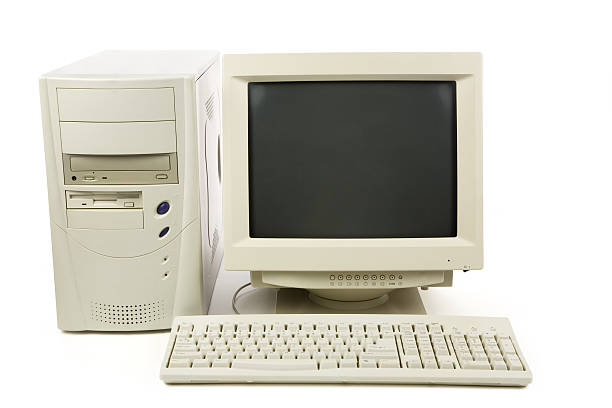
Have you ever wondered when writing a sentence, opening a file or playing a video, how does the computer read it or see it?
What is Binary?
Binary is a number system that only use two digits “1” and “0”. These two numbers represent all data and instructions in a computer. Computers use electronic signals in form of “ON” and “OFF”, which usually 1 for on and 0 for off (Lenovo).
How Computer translates, what you say?
A computer system is made up of both hardware and software components that work together to process output. A software is a set instructions called Programs, which direct hardware what is to be done and performs computation. On the other hand, hardware is the physical component which describes the physical capabilities of a system.
A computer program is written in human friendly programming languages such a C, C++, JAVA, PYTHON, etc. These are all much similar to English language and can be understood by learning programming objectives and syntax. These are also referred to as Higher Level Languages.
But computer only understands binary and so irrespective of any programming language you choose, all high level programs are required to be converted into binary code by using a special program called Compiler.
Compilers are very large programs, with error-checking and other abilities which translates high level program (Source code) written in a High level language into a set of machine-language instructions that can be understood by a digital computer’s CPU.
And so, at last whatever you say to a computer it’s converted into blocks of binary codes made up of 0’s and 1’s (Medium, 2023).
How Do Binary Numbers Work?
In binary, each binary digit (bit) can either be 0 or 1, which corresponds to the absence or presence of an electrical charge in a computer’s memory or storage device. In a computing system, binary is used as the foundation for binary code, which uses different combinations of the digits 0 and 1 to represent numbers, letters and other digital information.
Counting in binary numbers works similarly to counting in decimal numbers (digits 0 through 9), as when one digit reaches its maximum value, it has another digit added to its left to continue counting (i.e. there is no singular digit for ‘10’ in decimal, so 9 then turns into 10). However, unlike decimal numbers, binary numbers only work with the digits 0 and 1.
In binary, the decimal value of each bit depends on its position within a number, where the rightmost bit represents 2⁰, the next 2¹, then 2² and so on.
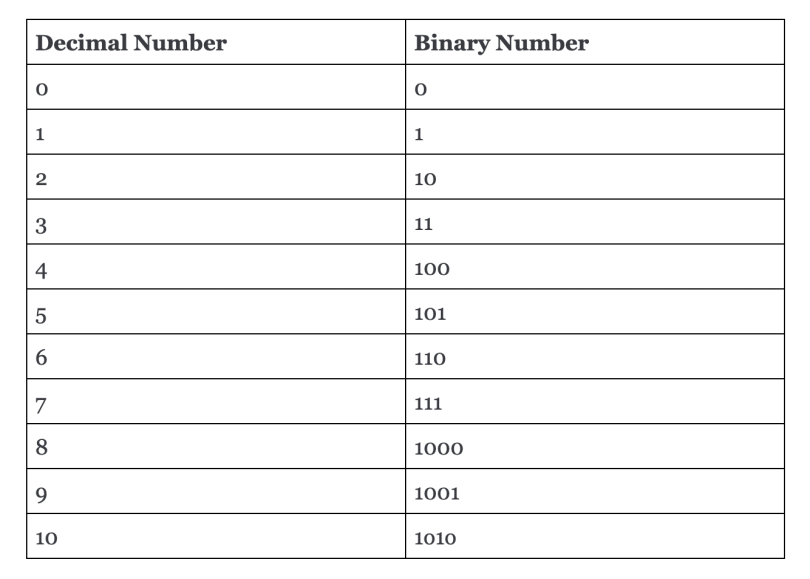
So in binary, decimal 0 equals binary 0 and decimal 1 equals binary 1, but decimal 2 equals binary 10. This is because binary has no digit greater than 1, so to represent a higher number than this, the rightmost digit will start again at 0 and have another ‘1’ digit added to its left. When all digits are 1 (e.g. 111), the next number resets them to 0 and adds a new 1 at the left (e.g. 1000).
Here’s what binary numbers looks like in comparison to numbers 0 through 10 in decimal:
For example, if you wanted to spell “Hello World” in binary, you would end up with this:
01001000 01100101 01101100 01101100 01101111 00100000 01010111 01101111 01110010 01101100 01100100
(Built in, 2025)
What Is ASCII?
ASCII (American Standard Code for Information Interchange) is a character-encoding standard that assigns a unique number to each letter, number, and symbol. These numbers are then converted into binary so computers can process them.
For example:
The letter A has an ASCII value of 65
In binary, 65 = 1000001
So when a computer stores or displays the letter A, it is actually working with the binary number 1000001.
ASCII typically uses 7 bits (or 8 bits in extended versions), allowing it to represent 128–256 characters such as:
Uppercase and lowercase letters
Numbers (0–9)
Punctuation marks
Control characters (like Enter or Tab)
How Do Letters Look in Binary?
Letters are simply numbers converted into binary form.
Examples:
A → 65 → 01000001
B → 66 → 01000010
a → 97 → 01100001
Each of these binary patterns is stored using bits (0s and 1s), which the computer reads as electrical signals (off/on). When the computer displays text, it reverses the process—converting binary back into characters we can understand (Text Platform, 2025).
References
Lenovo. What is Binary? https://tinyurl.com/5xrtc754
Medium. (2023, May). The Famous 0’s and 1’s: Why computer understands only Binary code? https://tinyurl.com/4pdhu2j4
Built in. (2025, June). What Is Binary? (Definition, vs. Decimal, Importance). https://builtin.com/software-engineering-perspectives/binary
Text Platform. (2025, February). What is Binary Code? Modern Language to the Binary System. https://tinyurl.com/ywe8xduk
 Write as you Breathe