Do some people think a cup is the same as donut?
Here I will be explaining a concept of math called “Topology” with a branch of it, which is the Knot theory, taking it a bit outside of mathematics into philosophy or in our daily life.
What is Topology?
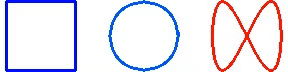
Topology studies properties of spaces that are invariant under any continuous deformation. It is sometimes called “rubber-sheet geometry” because the objects can be stretched and contracted like rubber, but cannot be broken. For example, a square can be deformed into a circle without breaking it, but a figure 8 cannot. Hence a square is topologically equivalent to a circle, but different from a figure 8.
(University of WaterLoo)
The definition of topology leads to the following mathematical joke (Renteln and Dundes 2005):
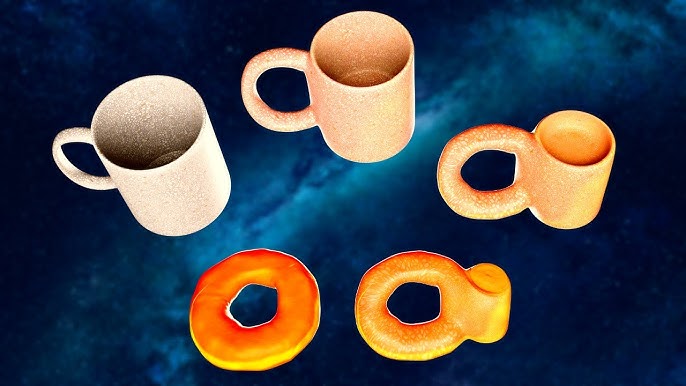
Q: What is a topologist? A: Someone who cannot distinguish between a doughnut and a coffee cup (Weisstein, Eric W)
To a topologist, if you can imagine the cup as a shape that can be twisted, un stretched and folded, then by imagining the handle of a cup as a knot of the surface circle; where we pour liquid inside the cup, by untying or unknotting this knot and forming it with bigger circle, and then lastly squishing the cup into a shape of a doughnut, then they are actually the same, since they have the same shape, properties and one actual hole.
What is the Knot theory?
Knot theory is a branch of mathematics focused on the study of knots, which are defined as simple closed curves in three-dimensional space. Within knot theory, mathematicians analyze the geometric properties of these knots, seeking to determine when two knots are equivalent—that is, when one knot can be transformed into another without cutting or intersecting itself. Several knot types exist, including the trivial knot (unknot), trefoil knot, and figure-eight knot, each distinguished by their unique crossing patterns. The field emerged in the late 19th century, influenced by early physicists who theorized about the atomic structure of matter through knots.
Knot theory extends into various scientific disciplines, notably physics, molecular biology, and cryptography. In molecular biology, for instance, it helps in understanding DNA replication—a crucial process where DNA strands untangle and replicate.
(Kivak, Rebecca, 2023)
And here I want to dispatch this article from the mathematical part to more a philosophical part.
First, Topology tells us about the emptiness in a knot, that has its own criteria, own characteristics and form, with doing some knotting, filling that emptiness can turn it to another shape with different criteria’s and characteristics, therefore, that declare that sometime the emptiness in something has actually meaning, being empty sometimes can form a fullness, can form a new set of meaning, you can apply that on relationships or time spent; for some cases of people, being lonely for them for a certain amount of time, can lead to form another human being, that is actually wiser, smarter, stronger or just prepare them for a next stage in life, so them being alone (empty) is being full for that certain period, going back to time, the time we consider “wasted” is actually preventing some other action, whether anybody use the metaphor of wasted time for any called action, it is actually preventing something else, since the person is alive, so they will do a certain action whether it is action “a” or action “b”, so by doing action “a” which is a wastage of time, it is actually
preventing action “b” from happening.
I would like to make it very clear on the two above examples, the loneliness part and time, they need not to be a positive or negative impact, they can be both, taking into consideration each person or scenario conditions, they are just filling the meaning of emptiness can also be being fully of something.
This also apply same to absence and presence, if you apply the same definition, you can obtain that absence or being absent of something, can make a more standout if it was present or you being present at something, same result, no need to be positive or negative, depends on the conditions.
And lastly, things that are connected and disconnected at the same time.
If you think about each detail of life or each action on a daily basis, a lot of them can be connected and disconnected at the same time, this actually connect to the butterfly effect to make it clearer.
A link if interested of getting to know the butterfly effect, also there’s a movie about it for whom ever interested. https://science.howstuffworks.com/math-concepts/butterfly-effect.htm
The actions that are tiny and nearly meaningless with variety of separated people or things, can tend to all connect together, if it’s more like a puzzle pieces with each one completing the bigger picture.
Personal advice, no need to take into consideration any form or situation, action as a big impact or overthink it, this all can be more productive, if you just accept each situation that cannot be change by your own force with knowing that all is a preparation for the upcoming stage.
References
University of WaterLoo. What is Topology? https://short.do/LgphIA
Weisstein, Eric W. “Topology.” From MathWorld–A Wolfram Resource. https://mathworld.wolfram.com/Topology.html
Kivak, Rebecca. (2023). Knot theory. https://short.do/t3KYzq
 Write as you Breathe